Tejvan organises short-distance running and cycling races for the Sri Chinmoy Marathon Team in his home city of Oxford. He is also a very good cyclist, having won the National hill climb championships in 2013 and finished 3rd in the National 100 Mile Time Trials in 2014.
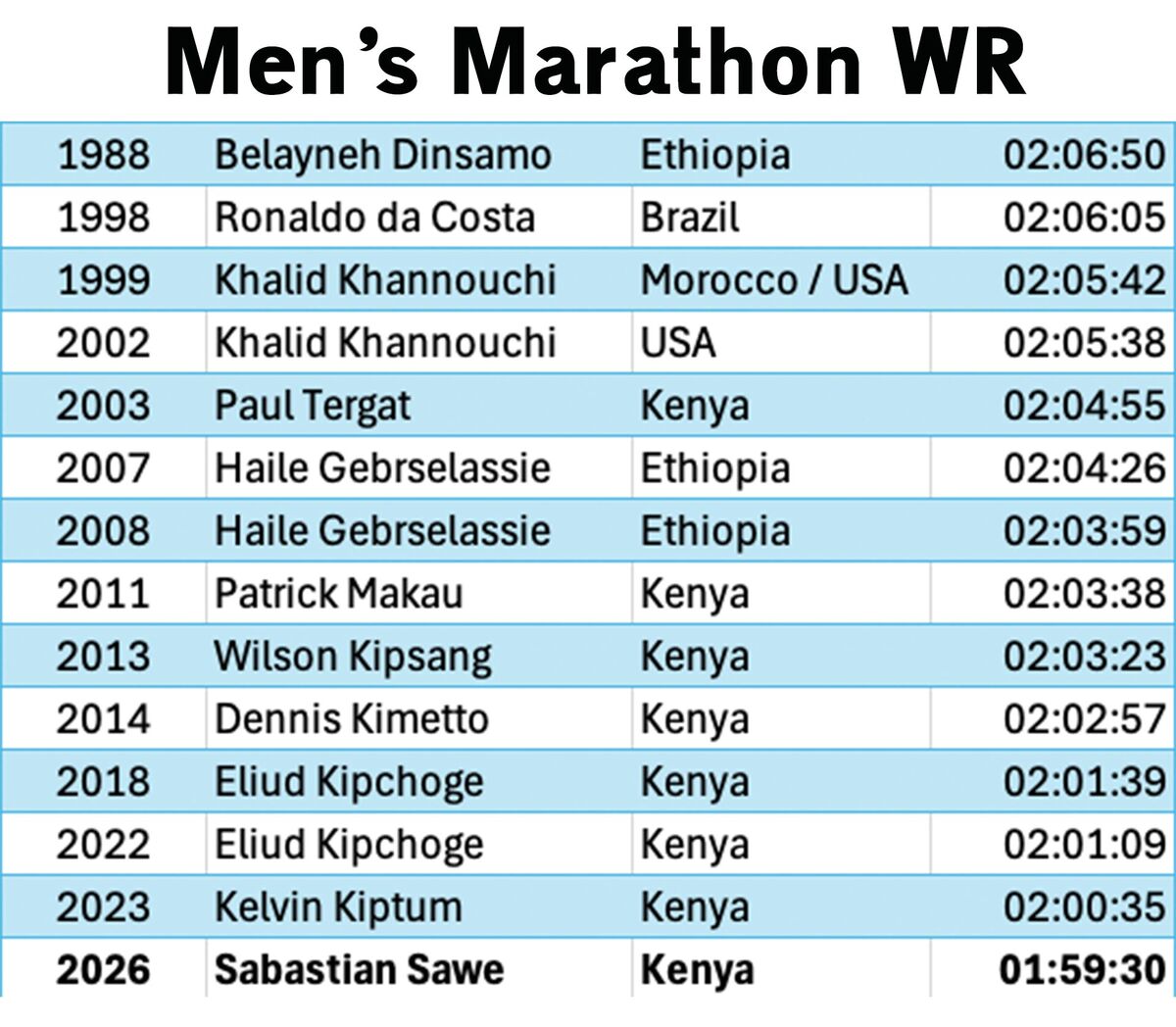
In a remarkable day at the London Marathon, two elite male runners passed under the magical two hour barrier for a marathon distance during race conditions. First over the line and passing the two hour barrier was Kenyan athlete Sabastian Sawe in a world record time of 1:59:30. Second place was Yomif Kejelcha (Ethiopia) in a time of 01:59:41. Third place Jacob Kiplimo (UGA) 02:00:28 was still inside the former world marathon record. In the women's race Tigst Assefa (Ethiopia set a new women's only world record in a time of 02:15:41.
It was a record breaking race in many respects, however, history will forever place a special mention on Sabastian Sawe's first marathon under two hours. A timing that was once considered 'impossible' in a way similar to the 'four minute mile' broken by Roger Bannister on 6 May 1954. To achieve this feat required an average pace of 4:33 per mile, an average speed of 13.16 mph. Yet, with London not considered the fastest course for marathon, Sewa has already talked about the possibility of running faster. It is notable that this is only his fourth ever marathon.
Whilst certainly improvements in technology of running shoes and the science of nutrition have helped improved performance, the results also illustrates the potential for human self-transcendence and the breaking of barriers once thought impossible.
Sub-Two Hour Prediction
In 1988 Sri Chinmoy wrote a prediction about a sub-two hour marathon
"Somebody has to come from Africa and break the record. Under two hours — I envision it. Somebody will run under two hours." Run and Become, part 21
At the time, the marathon world record was 2:06:50
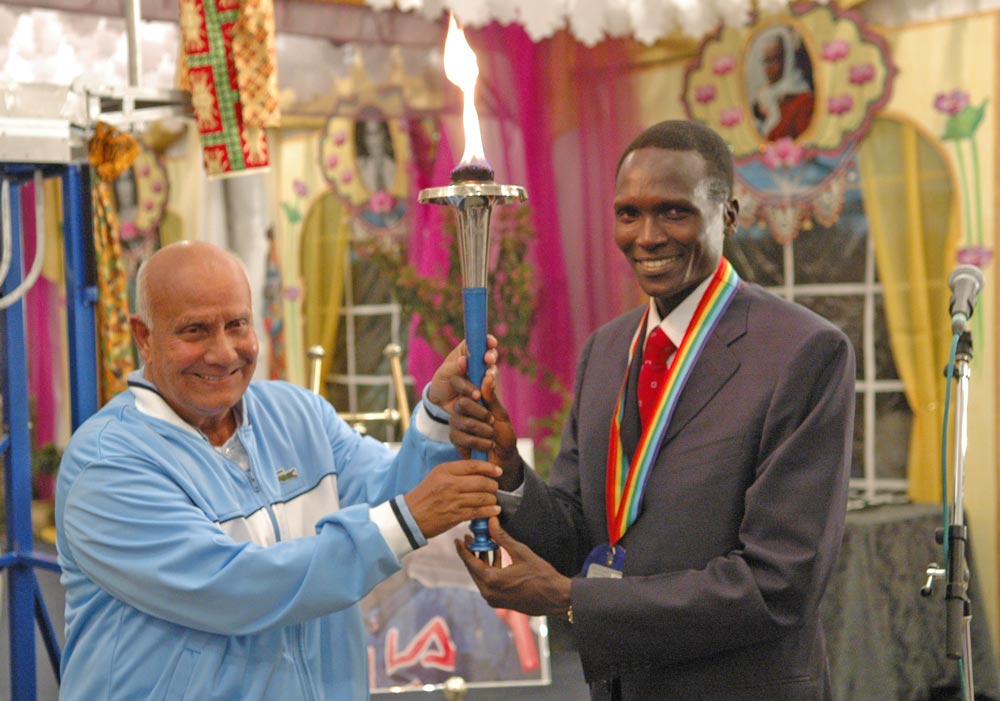
Sri Chinmoy with Paul Tergat, 2005
In 2005, Sri Chinmoy met Paul Tergat, the then current world record holder in a time of 2:04:05. At the time Sri Chinmoy said.
"Paul Tergat, the world’s fastest marathoner, covered the distance in two hours, four minutes. His record is four minutes over two hours, so my prediction is still hanging in mid-air!
I am praying that one day he or somebody else will run under two hours. Whoever runs under two hours will be given by me a very special honour, plus I shall meet with his plane fare and all his expenses, whether he comes from Kenya or anyplace else. I shall honour him most lovingly, cheerfully and proudly.
Who knows, who knows? There will be someone in the near future. I do not want to say in the distant future — no! In the near future, someone will be able to fulfil my prediction.