WorldwideSri Chinmoy Marathon Team

  • About us
  • Our races
  • Results

Search form

Founded by Sri Chinmoy in 1977, the Marathon Team is one of the world's largest organisers of endurance events.
read more »

Media Coverage

Articles & TV clips

History

From 2 to 3100 miles

Sri Chinmoy

Marathon Team Founder

Next Event:

23 June - London, GB
London Races in Battersea Park
Details »

Worldwide:

View full list »

Latest results:

9 September 2017 - ,
2017 Sri Chinmoy 6-Hour Hero-Cup Final Ranking
Details »

Worldwide results

Full list »

Gallery

By Anonymous
18 November

Click here to see all the albums (over 1300 photos from different parts of the world)...
 

Click here to see all the albums (over 1300 photos from different parts of the world)...

Cross-posted from

Sri Chinmoy Marathon Team articles - more articles

The spiritual significance of running

By Tejvan Pettinger author bio »
4 November

About the author:

Tejvan organises short-distance running and cycling races for the Sri Chinmoy Marathon Team in his home city of Oxford. He is also a very good cyclist, having won the National hill climb championships in 2013 and finished 3rd in the National 100 Mile Time Trials in 2014.

Sri Chinmoy believed that running is beneficial to physical health but also can give an inner spiritual fulfilment. Running teaches us determination, focus and reminds us of our aspiration to go beyond our previous limitations. Running is both physically challenging but, at the same time, gives an inner joy and satisfaction. Many runners attest to the fact that running can take us out of an ordinary consciousness and give a glimpse into a state of mind beyond our usual thoughts and emotions. 

“Running is a symbolic sport in the sense that it reminds us of spiritual seekers continuously running towards the goal; it resembles the seekers running inwardly to achieve the ultimate goal in meditation.”

Sri Chinmoy [1] 

Some of the spiritual aspects of running

Self-transcendence

“Self-transcendence gives us joy in boundless measure. When we transcend ourselves, we do not compete with others. We do not compete with the rest of the world, but at every moment we compete with ourselves. We compete only with our previous achievements. And each time we surpass our previous achievements, we get joy.”

Sri Chinmoy [2]

sri-chinmoy-newsday-marathon-blue.jpg
Sri Chinmoy ran 22 marathons and 5 ultramarathons, his first one being in 1979

Self-transcendence is concerned with an attempt to beat our previous achievement and stretch our capacity. This self-transcendence can be measured in a race against the clock, but even if we can't beat our times, we can still strive to make a greater commitment and effort in our training and races. If we are detached from the outer result, we will feel joy from these attempts at self-transcendence. Whilst we may not have the capacity to beat others, we always have the opportunity to pursue our own self-transcendence attempts.

Determination

Running brings forward both our outer and inner determination. Running requires effort, focus and the willingness to challenge our body against the distance and elements. To complete a race requires a fixed mindset and determination to keep going.
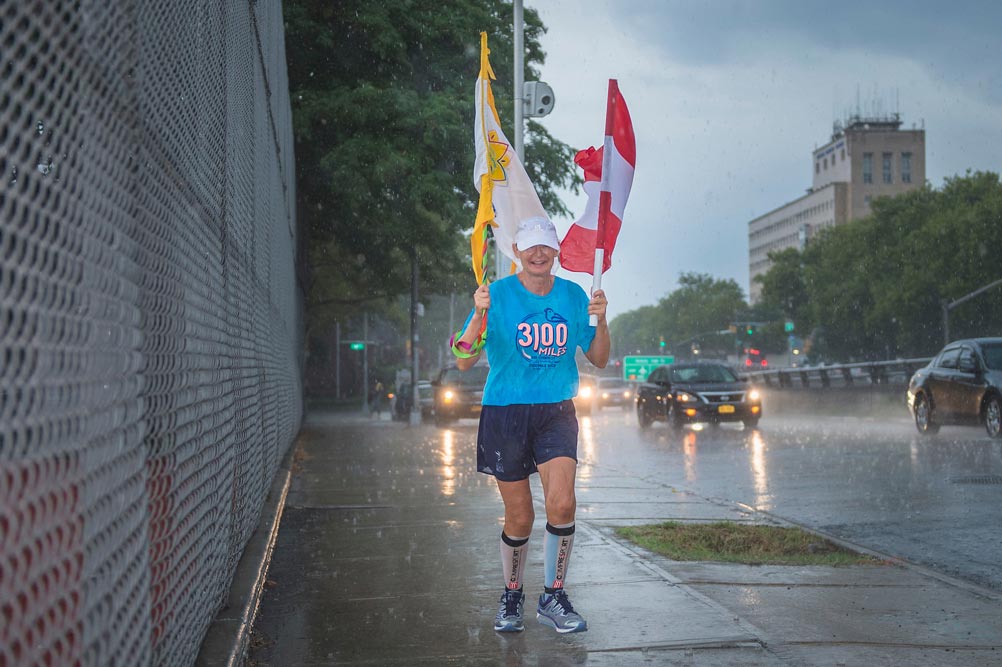
finish-inpouring-rain-surasa2.jpg
Surasa Mairer, holder of many women's ultradistance records, finishes the 2017 3100 Mile race at the age of 59

Getting to know yourself

“When a runner focuses all his attention on a particular race, he is in a position to free his mind, liberate his mind, from uncomely distractions. Here one-pointed concentration is the pathfinder for a deeper meditative consciousness.”

– Sri Chinmoy [3]

Running takes us out of our comfort zone. It teaches us that we are more capable than we perhaps realise. To a non-runner, completing a marathon may seem an impossible task, but if we train, we realise we are capable of much more than we realise. Whilst running, we get in touch with a different part of ourself, and we learn more about our inner reserves.

Dynamism and inner peace

Question: Can running help get rid of frustration and anger?

Sri Chinmoy: Running is an excellent way to rid oneself of frustration and anger. If you are really angry with someone, go and run. After a mile or so you will see that your anger has gone away, either because you are totally exhausted or because the satisfaction that you gain from physical exertion has replaced your anger. [4]

A great benefit of running is that it shakes away our mental cobwebs. The dynamism of running helps us to get away from the petty concerns and worries of our mind. Dynamism is a powerful tool to bring to the fore more inner peace. When we are static, we become like a stagnant pool, when we move, it is like a clear flowing stream. The Sri Chinmoy Oneness-Home Peace Run combines both running long distances with an endeavour to share peace. Sri Chinmoy felt the dynamism of running across countries was an excellent way to share peace in a meaningful way. Running brings many of our good qualities to the fore.
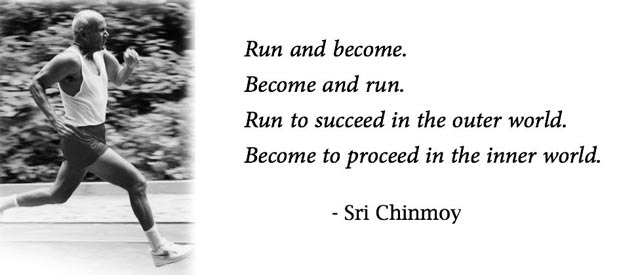
running-sri-chinmoy-640.jpg

How to bring spirituality into running

Self-transcendence vs competition

Rather than worrying about whether you can beat your competitors, focus instead on your own performance. Can you transcend your previous efforts? - Can you make the best possible effort given your circumstances? If you focus only on your self-transcendence, you will get joy from running - whatever the outer result. You will see fellow competitors - not as rivals, but fellow runners who can inspire your own efforts.
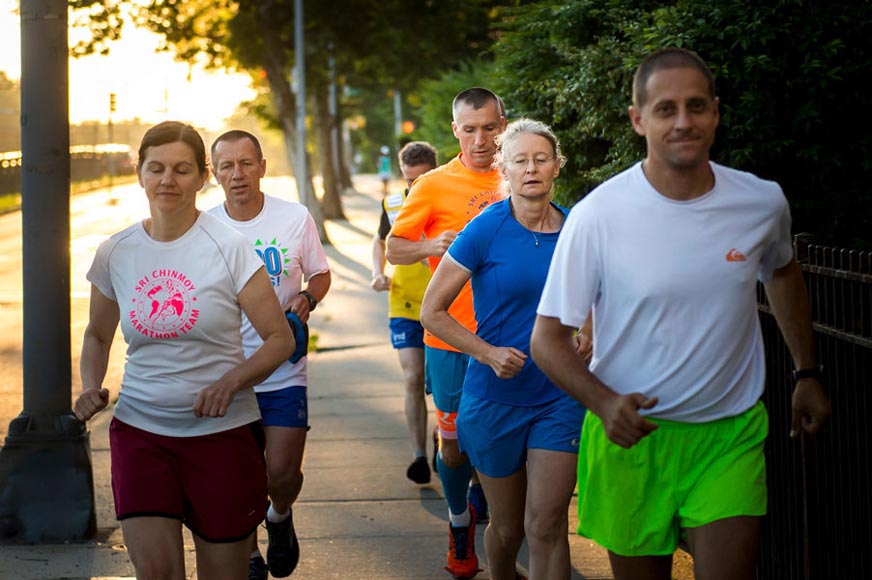
1st-lap.jpg
For runners in the 3100 Mile Race - the world's longest certified race - the focus not so much on competition as on bringing out the best in oneself

Meditation

If we meditate before running, we will be conscious of our inner stillness and inner reserves which can help us in the outer running. Meditation teaches us to be one-pointed and bring all our awareness of one aspect. When we run, we can see our running as an extension of our meditation. Just bring all your focus on to the running - the rhythm of breathing. Don't get distracted by thoughts, but just try to be the observer of the running. When the body is running, at top speed, feel at the same time an inner focus and inner equanimity.

"Again, the runner's outer speed has a special kind of poise or stillness at its very heart. An airplane travels very fast, yet inside the plane we feel no movement at all. It is all tranquility, all peace; and this inner tranquility we can bring to our outer life. In fact, the outer life, the outer movement, can be successful only when it comes from the inner poise."

- Sri Chinmoy [5]

Conscious Breathing

To make running a more meditative experience, we can concentrate on our breathing. We should feel our breath brings in not just oxygen but a divine energy. If we visualise we are breathing in cosmic energy and exhaling tiredness, we will gain more inner strength.

The inner value of running

"The main reason is that running reminds us of our inner goal. Whether we consciously run toward the goal or not, our very feeling that there is a goal helps us considerably."

- Sri Chinmoy [6]

If we value running as a spiritual exercise, then it can become something much more than just the outer running. When running, we can feel we are making inner progress and striving to reach our inner goal.


Perspectives on the spirituality of running

Running the world’s longest race – Jayasalini

Jayasalini Abramovskikh talks about the experience of running the Sri Chinmoy 3100 Mile Self-Transcendence Race. In 2014, at her first attempt, Jayasalini became the first Russian woman to finish this grueling race which lasts for 52 consecutive days.


Running as a pilgrimage

Sanjay Rawal, the director of the feature film "3100 Mile: Run and Become" talks about how he sees running as a spiritual pilgrimage.


Samunnati on meditation and running

Samunnati Lehonkova is an Olympic marathon runner who took up running at an early age after becoming a disciple of Sri Chinmoy. In this short video, Samunnati talks about how she started meditation and running at the same time, and how she attempts to practise self-transcendence through running.


3100: Run and Become

A film that explores the spiritual significance of running in different cultures across the world. It includes the Gaolo-San bushmen in Botswana, the legendary Japanese gyoman-san running monks, the Navajo runners in the deserts of Arizona, and the runners of the Sri Chinmoy Self-Transcendence 3100 Mile Race in Jamaica, Queens, New York.

Related

  • The inner significance of the Olympics
  • Article on Self-transcendence

Sources: Quotes are taken from the following books by Sri Chinmoy: [1] from Japan: soul-beauty’s heart-garden, [2] from The oneness of the Eastern heart and the Western mind, part 3, [3] from Run and smile, smile and run, [4] [5] [6] from The outer running and the inner running.

View full article »

Start of 2018 Sri Chinmoy Self-Transcendence 3100 Mile Race

By Tejvan Pettinger author bio »
18 June

About the author:

Tejvan organises short-distance running and cycling races for the Sri Chinmoy Marathon Team in his home city of Oxford. He is also a very good cyclist, having won the National hill climb championships in 2013 and finished 3rd in the National 100 Mile Time Trials in 2014.
  • The start
  • The race starts
  • The Runners on the first lap
  • Afternoon sun
  • Encouragement

On 17 June 2018, ten intrepid runners took to the start line of the world's longest certified road race - the 22nd edition of the Sri Chinmoy Self-Transcendence 3100 Mile Race. Over the next seven weeks, the runners will aim to complete a daily average of 60 miles or more in order to finish the race within the official time limit of 52 days. The runners have to contend with the hot New York summer, a hard concrete course and the many physical and mental challenges of competing in this epic of self-transcendence.

The race was founded by spiritual teacher and ultra-runner pioneer Sri Chinmoy, who saw distance running as a vehicle to enable runners to bring to the fore their physical, mental and spiritual capacities to complete this unique challenge.

“We have to believe in a higher Power.
Only by believing in a higher Power
Can we go beyond and beyond
Our limited, human capacity.”

– Sri Chinmoy [1]

In this year's race, we have the 2017 winner, Vasu Duzhiy from Russia. Also returning to the race is Kaneenika Janakova, from Slovakia who last year broke the women's world record, setting a time of 48 days+14:24:10. Proving that age is no barrier to ultra distance, the race also welcomes William Sichel (64) from Orkney, Scotland, UK. Sichel holds a host of Scottish and UK distance records and completed the race in 2014. Yolanda Holder, 60 years old and the only person to have racewalked the distance, also returns to the race after completing last year at her first attempt in a time of 51days+17:00:13. Surasa Mairer, former 3100 Mile women's record holder and current female world record holder for 1000 km, 700 miles, and 1300 miles is also starting.

View all runner's biographies.

First day's race

How to follow the race

This unique race has developed a following from all around the world. You can follow the race by viewing two race cams, daily results, daily blogs and photos.

  • Daily results at 3100 Mile Race
  • 3100 Mile home page - with Web Cam and race director's videos.
  • Perfection Journey - Daily race blog by Utpal Marshall
  • Photos by Jowan
View full article »

Six-day race champion Petra Kasperova featured in new book

By Tejvan Pettinger author bio »
16 June

About the author:

Tejvan organises short-distance running and cycling races for the Sri Chinmoy Marathon Team in his home city of Oxford. He is also a very good cyclist, having won the National hill climb championships in 2013 and finished 3rd in the National 100 Mile Time Trials in 2014.

superhumanPetra Kasperova from the Czech Republic, the winner of our Sri Chinmoy Six Day Race which took place this year in Flushing Meadows Corona Park in New York, was recently featured in a new inspirational book called Superhuman, by Rowan Hooper. The book looks at people who have achieved notable features of self-transcendence, and tries to answer what motivates them to reach for these goals. Petra finished this year's race with a total of 370 miles, at only her second attempt at running a multi-day event.

During the 6 day race, the runners can be out on the course for many hours at a time, and have to deal with numerous physical issues. Petra credits meditation with giving her the inner strength to overcome these obstacles.

I am certain I would never do so well in running if it wasn't for meditation and spiritual techniques that I have learned and applied during training and racing. The techniques can change from race to race and even during a race. I like to repeat mantras, qualities and prayers - that seems to help keeping my mind calm and focused. I try not to think at all, just to be focused. Repeating qualities like gratitude seem to keep my mind clear and make me more aware of what is going on inside of me and also outside of me.

Running is an integral part of Petra's life - she works in the specialist running shop Run and Become in London, where she advises runners on all manner of running issues. She often trains by running to work and back.

"I find that running has made me stronger, not just physically but on many different levels. It is always when we go outside our comfort zones, outside what we think is possible, when we transcend ourselves in any field of life (not just running), that's the time where we need to dig deep, and when we do, we get glimpses of who we truly are and who we really want to be – for a happy self and a happy world."

petra-champions-1022553-utpal.jpg

The winners of the 2018 Sri Chinmoy 6 and 10 Day Races: (l-r) Asprihanal Aalto, John Geesler, Ilvaka Nemcova and Petra

Related

  • Petra's Victory in the Six-Day Race 2018 at Run and Become
  • Six-Day Race at Sri Chinmoy Races
  • Superhuman by Rowan Hooper at Amazon

Photos: Utpal Marshall. Perfection Journey

View full article »

Sri Chinmoy on the best attitude to take towards competition

By Nirbhasa Magee author bio »
11 June

About the author:

Nirbhasa is from Ireland. He is an enthusiastic multi-day runner, having completed four times the Sri Chinmoy Self-Transcendence 3100 Mile Race - the longest race in the world.

The philosophy behind Sri Chinmoy’s races is one of self-transcendence - getting joy by transcending one’s own capacities. However, he felt that competitive races did have their own value, provided it was done in the proper spirit. Here are some of his writings on the best frame of mind to approach competition:

27_aug_1979_47_miles_1.jpg
Sri Chinmoy finishes a 47-mile race in 1979, at the age of 48

In competitive sports, our primary aim should be not to surpass others but constantly to surpass ourselves. In the outer life, when we run with our friends, we are seeing who is actually the best. And we cannot properly evaluate our own capacity unless we have some standard of comparison. But we compete not for the sake of defeating others, but in order to bring forward our own capacity. Our best capacity comes forward only when there are other people around us. They inspire us to bring forward our utmost capacity, and we inspire them to bring forward their utmost capacity. This is why we have competitive sports.

The value of competition is that you will try to transcend your capacity. If you lose to somebody after trying your best, it is absolutely immaterial. But if you don’t make progress even here on the physical plane, then you won’t try to make progress on the spiritual plane. At that time you will say, “I get up at 7:00 or 8:00 and then once in a blue moon I meditate. Who is going to see?” If you are sincere about making progress on the spiritual plane, then you can start your sincerity with the physical plane. Then the progress you make will spread to the mind and to the heart. I wish to say that there is nothing wrong with a competitive spirit, provided it is competitive in a good sense. You are competing with yourself. 

While competing with others,
We see that our competition
Is actually with ourselves.

I always say that the goal is not static; the goal is an ever-transcending reality. Satisfaction is our goal, but we see that the goal itself is climbing high, higher, highest and running far, farther, farthest and diving deep, deeper, deepest.

A child's goal is to learn the alphabet. Then his goal becomes kindergarten, primary school, high school and college. And when he completes his university course, if he is sincere, he comes to realise that there is much more, infinitely more, for him to learn. Once a university student was boasting of his achievements. He said to Mother Earth, "I have completed my course. So look at me, look at what I have achieved." But Mother Earth said, "My son, you have just learnt the first letter of the alphabet. Now sit down and learn the rest."

The goal is constantly going high, higher, highest. Whatever we achieve can be today's goal, but it can never be tomorrow's goal. Tomorrow's goal is something infinitely higher, infinitely more illumining and infinitely more fulfilling. Perfection, which is satisfaction, is nothing short of constant self-transcendence. So here I wish to say that we do compete, but we compete with ourselves, with our own achievements, not with others.

References

The above writings were taken from Sri Chinmoy’s books The inner meaning of sport, A Twentieth Century Seeker, The body: humanity's fortress and Seventy-Seven Thousand Service-Trees

View full article »

Sri Chinmoy Multisport Classic in Jindabyne [video]

By Tejvan Pettinger author bio »
14 March

About the author:

Tejvan organises short-distance running and cycling races for the Sri Chinmoy Marathon Team in his home city of Oxford. He is also a very good cyclist, having won the National hill climb championships in 2013 and finished 3rd in the National 100 Mile Time Trials in 2014.

The Sri Chinmoy Multisport Classic, held in Jindabyne, is a unique multi-sport event held in the beautiful surroundings of Australia's Snowy Mountains. The annual event has been held for several years and combines water and land-based sports over 12 different legs.

The event attracts a diverse range of athletes who can compete either individually or part of a relay. This video, produced by Sarankhuu Jargal, shows highlights from the different sections including running, swimming, mountain biking and paddling. Steve Hanley a former winner also gives his brief thoughts on why he enjoys the race.

The course is varied, with 3 mountain bike legs ranging from easy to highly technical; 3 running courses from flat to very not-flat; 3 swims of between 1.2 and 2.5 kms; and 3 paddles of 5.5 to 9.5 kms. The swims and paddles criss-cross most of Lake Jindabyne, while the mountain bikers and runners thoroughly explore the rugged Eastern Escarpment, rolling farmland of the Western Shore, and bushland of the adjoining Kosciuszko National Park.

The event is organised by the Canberra/Australia Sri Chinmoy Marathon Team.

Related

  • The Sri Chinmoy Multisport Classic
  • Race reports from participants
View full article »

Interview with our Olympic marathoner Samunnati

By Nirbhasa Magee author bio »
22 January

About the author:

Nirbhasa is from Ireland. He is an enthusiastic multi-day runner, having completed four times the Sri Chinmoy Self-Transcendence 3100 Mile Race - the longest race in the world.

Samunnati Nataliya Lehonkova from the Sri Chinmoy Marathon Team represented the Ukraine in the 2016 Olympic marathon in Rio, and has also won marathons in Los Angeles, Dublin, Edinburgh, Belfast and Toulouse. Her most recent win, in the 2017 Dublin marathon, established a personal best of 2:28.

In this video, Samunnati sat down with her friend and 3100 Mile race finisher Jayasalini Abramovskikh and talked about becoming a meditation student of Sri Chinmoy at the age of 12 and how that slowly led to her running longer and longer distances. She also talks a little about her training schedule, and how Sri Chinmoy's philosophy of self-transcendence inspires her to run.

Before she became a professional runner, Samunnati was a regular on the international Peace Run team; she reminices a little about travels all around Europe and Australia carrying a torch for world harmony.

View full article »

Nataliya Samunnati Lehonkova wins Dublin Marathon

By Rupantar LaRusso author bio »
30 October

About the author:

Rupantar has been the race director of the Sri Chinmoy Marathon Team since 1985, having been asked by Sri Chinmoy to serve in that capacity. As well as working on the big races the US Marathon Team organise each year - the 3100 Mile Race and the Six and 10 Day Race - he also spends a considerable amount of time archiving the Marathon Team's 40 year history on this website.

Nataliya Samunnati Lehonkova, a member of the Sri Chinmoy Marathon Team who competed for her native Ukraine in last year's Olympics in Rio, won the woman's elite field in the Dublin SSE Airtricity Marathon. On a rainy windy day, she finished in a personal best time of 2:28:57.

natalie-lehonkova.jpg  

Picture below: Samunnati with friends from the Sri Chinmoy Marathon Team in Dublin after the awards ceremony. Samunnati has won the Dublin Marathon before, as well as winning the Edinburgh, Tolouse and Los Angeles Marathon

sumannati_medal.jpg

Nataliya Samunnati Lehonkova at Awards Ceremony

Related

  • News item on Ukrainian TV (in Ukrainian)

Photo top: Nataliya Lehonkova in 2015 Dublin Marathon. Photo William Murphy CC SA

View full article »

Multi-day tips, part 2: Coping with rainy weather

By Smarana Puntigam
8 September

This is the second in a series of articles from Smarana Puntigam, a 20-year veteran of multidays, on dealing with the many challenges that a multi-day race can throw up...

Rainy weather is a real challenge for a multiday runner. The rain can soak through and make you cold and miserable, and also lead to chafing and blisters. Keep an eye on the weather reports and try and anticipate what the rain is going to be like, and plan accordingly.

1. Keeping dry

There are multiple options that one can choose from, depending on the type of rain and your physical strength at the time.

rain.jpg
Rain solutions, from left: 1. Ponchos, 2. Small umbrella and O2 jacket, 3. Large umbrella, 4. O2 jacket and trousers
  • A cheap plastic raincoat is very efficient and keeps the rain out. However, if used for a long time, it may lead to overheating. After a while, you also get wet from inside because it is not breathable.
  • Even with breathable jackets, overheating and sweating is an issue, particularly with heavy Gore-tex jackets and trousers. There are paper thin rain coats and trousers on the market, for example those from H2, that are breathable and also quite inexpensive. Some runners cut the legs of their trousers short to allow more breathing.
  • Running with an umbrella has the advantage of not sweating as much, and also keeping the rain off your feet for a while. But in the course of time it needs extra energy to carry. Smaller umbrellas are better for running; for walking and shorter periods of time bigger umbrellas keep the feet dry for longer. 
  • Ponchos keep the rain off and allow the air to circulate inside, however they can be troublesome in windy conditions.
  • For short spells of rain, you can also try and time your breaks to coincide with the rain. Some areas (such as NY) are more difficult to predict the exact arrival of weather than others due to competing weather systems, however usually the forecasting models 'converge' an hour or two before the rain starts and you should be able to plan with plus or minus 15 minutes accuracy.

2. Chafing

As soon as there is moisture and friction, the danger of chafing is very high.

  • It might be possible to tape areas that are likely to chafe.
  • Before you get a problem you can also apply petroleum or other creams that help to reduce the friction - in the long run, however, it is better to keep these areas dry. Corn starch is a very efficient solution, as is talcum powder with zinc, or powder with essential oils.
  • Compression shirts and compression tights can be a big help in rainy weather to prevent chafing.

3. Blisters

The most important thing for a runner is to keep his/her feet dry. If your feet are wet, the likelihood of blisters multiply exponentially. 

  • If the rain is scheduled only as short and heavy rain, try to run with a large umbrella to keep the rain off your feet.
  • Some runners apply coconut oil or olive oil to their feet, before it rains, so that the feet do not absorb water and crumple up the skin.
  • Change shoes and socks as soon as the rain is over, and apply powder to your feet for faster drying.
  • During longer spells of rain, you should not run for too long without changing your shoes and socks - a good rule of thumb is 90 minutes, although you may have to change sooner if your feet are more sensitive. A prepared runner will pack enough socks to last a long spell of rain. It is obviously more difficult to have as many shoes, but you should have at least 2 pairs on standby in addition to the pair you are running in. If it looks like the rain will last longer than a few hours, you can dry your shoes by stuffing them with tightly-rolled newspaper, which will absorb the water. A good helper saves you a lot of time here, especially because you may have to replace the newspaper after 90 minutes or so if the shoe got completely soaked. However if the rain persists and you need to use the shoe again after 3 hours, it should be dry or almost dry.
  • When the sun is back out, remove the insoles and leave shoes and insoles to dry in the sun.
View full article »

Multi-day tips, part 1: How to avoid BLISTERS!

By Smarana Puntigam
8 September

Smarana Puntigam has been running multiday races for over 20 years, including the 3100 mile race eight times. This is the first of a series of articles on dealing with common issues that crop up during multiday races...

How to avoid blisters? - that is a big one for a multiday runner. If you do shorter races, blisters are inconvenient, but easy to deal with because you do not have to run on them the next day. However, once you have blisters in a multiday event they can really influence your performance a great deal. Depending on the area the blisters appear in, and whether they get inflamed, the range of pain goes from hardly-felt to “I think I have to stop, I just can not take the pain.“ So, the best thing is always to prevent blisters in the first place.

Here are the main issues to deal with:

1. Wet feet

One of the most important things is to keep your feet dry - if there is a lot of moisture, the skin gets very sensitive and prone to blisters.

  • powder.jpgPowdering your feet several times a day with foot powder or baby powder can help you to reduce the friction in the shoes and to keep your feet dry. There are also excellent crèmes that keep the feet soft, elastic and reduce also the friction. Vaseline is not so good, because it does not allow the feet to breathe and I always feel that my feet are sliding around too much inside the shoes. However from my experience if the race is longer than a day, powder is the way to go.
  • There are runners whose feet simply sweat more than others, and who will always have wet feet. Many runners cut open their shoes to let the steam and heat out of their shoes.
  • Rain makes the skin on your feet 'crumple' and become much more blister-prone. Our article on rainy weather has a whole section on this... 

2. Choose your socks wisely

  • The big variety of socks is sometimes confusing - there is such a big selection of socks, each promising their own special feature.
  • Don't use cotton socks - they get soaked with sweat and moisture, which does not go away. This was one of my main problems when I started ultra-running and that is why I got a lot of blisters. Dipali Cunningham, one of the leading female multi-day runners, was shocked when she saw me showing up for my first 700 miles race with cotton socks, and gave me valuable information in this regard.
  • Use socks that are not too thick and are made of a fabric that does not store water (i.e. coolmax). For example Nirbhasa Magee, who ran the 3100 Mile race in 2015 and 2017, is very fond of WrightSocks, a thin sock with a double layer - this means the layers of the scok rub against each other rather than the skin. 

3. Ill-fitting and narrow shoes

  • cutaway-shoe.jpg
    Cutting to avoid an upcoming blister on the side of the foot, just below the toe
    Don't take new shoes for marathons or long distances; it takes some time for the shoes to get the right shape for your feet. They have to get used to one another. The shoe size should be at least one number bigger than the size of your foot, with plenty of room in the toebox so your toes don't rub against the front.
  • When you are running ultra distances your feet keep swelling, and you may need extra wide shoes. The first day you can still run in your usual running shoe, but as the race progresses, your feet keep changing. A shoe that perfectly fits on the morning of the third day of a multi-day rice, might not fit any more in the evening.
  • Also you may need a different insole, or to cut the one you have. The insoles that come with the shoes are not flat in the heel area, but have edges that bend upwards. As your foot swells, the heel doesn't fit any more into the area of the insole and the edges of the insole can cut into the heel and sides of the foot, creating blisters.
  • Blisters or potential blisters on the toes or sides of the feet might be alleviated by cutting away the part of the shoe that is rubbing against it, as long as it does not affect the shoe's stability. You will probably need to cut down all the way to where the top of the shoe joins the sole to remove the friction.

4. Hot feet

Where there is friction, there is heat.

  • Some use creams to reduce the friction, but on the long run from my experience powder is the way to go, since it keeps the feet dry and reduces the friction.
  • Again, cutting your shoes reduces heat as well as friction.
  • There are creams that help to cool down your feet. The skin absorbs the cream, so that you can take powder after some time.
  • During breaks, you can put your feet into a plastic bag and put them into ice water to cool them down and reduce the swelling.
  • Changing your socks and shoes frequently will help to air the feet and get rid of moisture and heat. 

5. Taping 'hot spots' and callouses

  • As a runner you most probably know your 'hot spots' - areas of the feet that very easily turn hot or red during a run. If you don't know them yet, check your feet after a longer run and try to locate them. Once you do know them tape them before ultra runs. You can use paper tape or very thin tape, but do not use kinesiology tape - it creates a lot of heat and you will get blisters right there.
  • If there is a callous - very often in the heel section - take it away with simple sand paper or special tools from the drug store. When the feet start to swell during multi-day runs, the normal skin is elastic and can expand, while the callous cannot. Spots like that are predestined for blisters.
View full article »

Sri Chinmoy on how meditation can benefit athletes

By
15 August

As well as being a fitness pioneer, Sri Chinmoy conducted peace meditations at the United Nations for 37 years. Here are some of his writings on how meditations can benefit athletes:

Inner peace gives us inner strength

img020.jpg
Sri Chinmoy finishes a marathon, 1983

When we meditate, we make our mind calm and quiet. If inside us there is peace, then we will derive tremendous strength from our inner life. That is to say, if I have a peaceful moment, even for one second, that peace will come to me as solid strength in my sports, whether I am running or jumping or throwing. That strength is almost indomitable strength, whereas if we are restless, we do not have strength like that.

Look at an elephant. An elephant has tremendous strength. It is not restless like a monkey which is moving here and there. It is exactly the same for us. In our inner life if we have the strength of an elephant, then only in our outer life can we be peaceful. A lion is very peaceful. Then when something happens, he starts roaring. But its strength is the peace that it has. It has confidence. But a monkey and other animals that are very, very restless, what kind of strength do they have? Meditation gives us inner strength. Once we have inner strength, we are bound to be successful in our outer life.

Through meditation we can find peace, and once we have peace of mind, impossibility cannot exist for us.

An infinite source of power

Because of our limited mind, because of our doubting mind, because of our suspicious mind, we have limited ourselves and we always think that we cannot go farther, deeper or higher. We are stationed at one place. There is no hope for us to come out of this mental prison. But no, we can come out on the strength of our prayer and meditation and fly in the sky of Infinity.

The physical mind has to be transcended by inner prayer. When you can transcend the limitations of the mind, at every moment you can perform so-called miracles. In the inner world, however, there are no such things as miracles. They exist there as realities. We bring them down into the material world to prove that there is something called inner power.

We can draw upon the cosmic energy by entering into our deeper consciousness, the all-pervading consciousness, which is here, there, everywhere. It is the inmost consciousness that touches the springs of the cosmic energy. If we can have a free access to our inmost consciousness, the cosmic energy is bound to come to the fore. If you go deep within, it comes like a spring, a never-failing spring. And when it comes, it permeates the whole body.

This article was written as part of the Sport and Meditation series.

Video: Sri Chinmoy in silent meditation.

Sources:

  • Lifting Up the World with a Onenness-Heart, by Sri Chinmoy
  • Run and smile, smile and run, by Sri Chinmoy
  •  
View full article »

Sri Chinmoy on racing and competition

By
12 August

Sri Chinmoy completed 22 marathons, 5 ultras and countless sprinting and middle distance races over a career that lasted many decades. He always felt that running and meditation should go together, and that competitions and races could help one inwardly progress as long as the runner had the right attitude. Here are a selection of his writings on running and competition:

The value of competition

We cannot properly evaluate our own capacity unless we have some standard of comparison. Therefore, we compete not for the sake of defeating others but in order to bring forward our own capacity. Our best capacity comes forward only when there are other people around us. They inspire us to bring forward our utmost capacity, and we inspire them to bring forward their utmost capacity. This is why we have competitive sports.

Before a race

Before the race starts, meditate most soulfully for five minutes. Try to make yourself feel that you are not the runner, but that somebody else is running in and through you. You are only the witness, the spectator. Since somebody else is running, you are at perfect liberty to watch and enjoy. While you are running, sometimes it is very difficult to enjoy the race. Either the competitive spirit or frustration is killing you, or your body is not abiding by your mental will and you feel that you are literally dying. So many problems arise.

100 metre.jpg
Sri Chinmoy competes in the 100m in the World Masters Games, Puerto Rico, 1983

But before you start, if you can convince yourself that you are a divine observer and that somebody else is running in you, through you and for you, then fear, doubt, frustration, anxiety and other negative forces will not be able to assail your mind. Once these thoughts occupy the mind, they try to enter into the vital and then into the physical. Once they enter into the physical, they create tension, and this makes you lose all your power of concentration. But if you feel that you are not the runner, if you feel that you are observing the race from the beginning to the end, then there will be no tension, and these forces will not attack you. This is the only way to overcome these forces and maintain the highest type of concentration from the beginning to the end.

This is what I do. Right from the beginning I try to become an instrument and feel that somebody else, my Beloved Supreme, is running in and through me. At the beginning of the race, I offer my gratitude-heart to the Supreme, and at the end, after I finish the race, I also offer my gratitude. If you can offer your soulful gratitude to your Inner Pilot before the race, during the race and after the race, then there can be no frustration, no decline of aspiration. Your aspiration and your power of concentration will remain the same throughout the race.

Coping with losing

To cope with the disappointment of losing, you have to ask yourself whether the mind is disappointed or the heart is disappointed. You will come to realise that it is your mind that is disappointed and not your heart. The mind creates division; the mind is division itself, and division is another name for pain, devastating pain. The heart, on the other hand, creates oneness; in fact, the heart is oneness itself, and oneness is another name for joy, spontaneous joy. When you live in your heart, even if your worst rival wins the race, you will not feel miserable. To your wide surprise, you will find that his joy quite unconsciously and unexpectedly will enter into you and widen your heart. Then you will feel almost the same joy that the winner feels.

This article is part of the Sport and Meditation series on this website.

View full article »

New women's world record in 3100 Mile Race

By Tejvan Pettinger author bio »
6 August

About the author:

Tejvan organises short-distance running and cycling races for the Sri Chinmoy Marathon Team in his home city of Oxford. He is also a very good cyclist, having won the National hill climb championships in 2013 and finished 3rd in the National 100 Mile Time Trials in 2014.
  • Kaneenika Janakova sets new women's record for 3100 miles
  • Vasu Duzhiy finishes 3100 Mile Race in 1st Place
  • Crowds greet Vasu on his finish
  • Kaneenika with 13 time finisher Suprabha Beckjord
  • Kaneenika with Yolander Holder still racing
  • Nirbhasa finishes 3100 Mile race in 3rd place
  • The 3100 Mile race lasts 52 days
  • Racing into the evening
  • Racing late into the night
  • "Self-Transcendence is eagerness in action" - Sri Chinmoy
  • Sri Chinmoy - the race founder

48 days and 14 hours after starting the Sri Chinmoy Self-Transcendence 3100 Mile Race, Kaneenika Janakova,47, of Bratislava, Slovakia set a new women’s world record for the distance. Her final time was 48 days+14:24:10, averaging over 63 miles for nearly two months of daily racing.

Kaneenika broke the previous women’s record set by Surasa Mairer by over 17 hours. Her performance was also sufficient to finish 2nd overall.

After a difficult opening few days, Kaneenika was a model of consistency averaging well over the required minimum daily distance of 60 miles. She remarked how over the course of the race she felt stronger - despite the accumulation of miles and physical fatigue.

“At the beginning of the race I actually didn’t feel so strong, the first week and maybe even 10 days.  But then all of a sudden it felt as though I was gaining the strength.  It just all started happening.   It was all coming from inside.” - Kaneenika

Vasu Duzihy overall winner

vasu


The overall winner of the race was Vasu Duzhiy 51, of St Petersburg, Russia, who won the 21st Annual Sri Chinmoy Self-Transcendence 3100 Mile Race for the second time in 46 days+17:38:22. It was Vasu’s sixth consecutive finish and his second consecutive first place. His performance was all the more remarkable for a serious back accident eight months ago, which left him unable to train and barely able to stand. Speaking after the race, Vasu expressed his joy of competing in the contest.

“I love this race.  I don’t know why I love it.  I just love it and do it.  I am happy here and I am able to do self transcendence. I hope that I can inspire some people to be better citizens of the world.  They inspire me and I inspire them.” - Vasu

Over 100 spectators came to see the finish of the runners who had braved extremes of temperature, sickness, and the unremitting nature of the concrete block which had been their home and sporting pilgrimage for the past several weeks.

3rd place for Nirbhasa Magee

nirbhasa


On Saturday night, Nirbhasa Magee, a native of Dublin, Ireland finished second man, third overall in a personal best time of 48 days+16:47:01. It was Nirbhasa’s second attempt at the distance, managing to improve his finish time by two days plus 19 hours faster than his previous effort in 2015. For Magee, the spirit of self-transcendence is the essence of the race, remarking:

“It is nice to transcend yourself…  I am not leaving anything on the table.  It is not like I am taking it easy.  What you see from me every day is my absolute best that I can put out." - Nirbhasa


race The race continues for a few days with Harita Davies (NZ) and Yolanda Holder (US) within striking distance of finishing the race within the allotted time of 52 days.

Follow the race at:

  • 3100 Mile race at Sri Chinmoy Races
  • Perfection Journey by Utpal
  • Photos of race by Jowan
View full article »

Self-Transcendence 3100 Mile Race - 2017

By Tejvan Pettinger author bio »
21 June

About the author:

Tejvan organises short-distance running and cycling races for the Sri Chinmoy Marathon Team in his home city of Oxford. He is also a very good cyclist, having won the National hill climb championships in 2013 and finished 3rd in the National 100 Mile Time Trials in 2014.
  • Group before the race
  • On the course
  • Smarana
  • Harita and Nidhruvi
  • Sahishnu one of the main organisers
  • Yolander Holder
  • Two runners
  • The 3100 Mile Race
  • Singers on the course


This year sees the 21st edition of the Self-Transcendence 3100 Mile Race. 10 runners took to the start line on June 18th to embark on the epic quest to complete 3,100 miles over the course of 52 days. Each runner will need to tap into deep reserves of - stamina, fitness, and inner strength - to meet the 60 mile a day average needed to complete the race. The race was founded by Sri Chinmoy, a spiritual teacher keen to promote physical self-transcendence as a way to the inner and outer enlightenment.

The race attracts international media attention for the unique personal challenge it presents. The race promoted by the Sri Chinmoy Marathon Team has an international flavour with runners drawn from Europe, US and New Zealand. In addition to the ten runners a team of volunteers look after the runners through cooking, medical team and lap counters.

    “Go beyond, farther beyond!
    Do not limit yourself
    By comparing yourself with others
    Or even with your own self.”

– Sri Chinmoy

Sri Chinmoy, Twenty-Seven Thousand Aspiration-Plants, Part 99, Agni Press, 1984

Photos

Jowan and Utpal.

  • Daily updates at 3100 Mile Race

Daily blog by Utpal at Perfection Journey


The runners this year include:

Vasu Duzhiy Age 51, St. Petersburg, Russia (5 finishes, 1 win)
Smarana Puntigam 46, Vienna Austria. Seven straight finishes.
Nidhruvi Zimmermann, 51, Vienna, Austria
Nirbhasa Magee, 37, Dublin Ireland
Andrey Andreev, 51, St Petersburg Russia
Sergey Kuzmin, 44, Nizhniy Novgorod Russia
Kaneenika Janakova, Age 47, Bratislava, Slovakia
Ananda-Lahari Zuskin, Age 42, Kosice, Slovakia
Yolanda Holder, 59, Corona,CA USA
Harita Davies, 42, Christchurch New Zealand

Full bios of runners

View full article »

Looking back: 40 years of the Sri Chinmoy Marathon Team

By Rupantar LaRusso author bio »
16 March

About the author:

Rupantar has been the race director of the Sri Chinmoy Marathon Team since 1985, having been asked by Sri Chinmoy to serve in that capacity. As well as working on the big races the US Marathon Team organise each year - the 3100 Mile Race and the Six and 10 Day Race - he also spends a considerable amount of time archiving the Marathon Team's 40 year history on this website.

The Sri Chinmoy Marathon Team celebrates its 40th birthday this year. Local Marathon Team director Sahishnu Sczcesiul writes about how the Marathon Team grew from Sri Chinmoy's philosophy of self-transcendence to the largest organiser of ultradistance and endurance events.

The Marathon Team is named after its founder and guiding light, spiritual Master Sri Chinmoy. The meditation leader had been a stellar athlete during his youth in his native India, excelling in sprinting, decathlon, soccer and volleyball in the spiritual community where he lived. Based in New York since 1964, he inspired his students to live a fulfilling life integrating the peace of meditation with the dynamism of action, particularly sport. The “self-transcendence” aspect of his philosophy was complemented by service to the world.

Sri Chinmoy resided in Jamaica, Queens, NY, in a quiet community, where he was joined by many of his followers. Like their teacher, they, too, were becoming runners, with his constant encouragement. Beginning in 1970, the Sri Chinmoy Centre Sports Day provided an annual opportunity for them to participate in track and field events. But long-distance running would become the hallmark of the Sri Chinmoy Marathon Team. In 1976, 33 students of the Master ran the non-stop Liberty Torch relay through the fifty states, carrying a flaming torch to honour America during the Bicentennial year. Long-distance running soon featured prominently in the spiritual life of Sri Chinmoy’s students—for itself, and for the symbolism of the endless journey to perfection.

Sri Chinmoy urged his students to offer running races to the public—for dynamism, energy and joy, as well as fitness and health. The first running event in the history of the Sri Chinmoy Marathon Team took place on October 2, 1977, in the hills and dales of Greenwich, Connecticut.

start 13 mile 1979.jpg
A 1979 half-marathon in Flushing Meadow park, with over 500 people


The sprinkling of running races on the SCMT calendar would eventually become a flood, as new events of varying distances emerged (2 miles, 10K, 10 miles). Sri Chinmoy himself ventured into long-distance running in 1978, completing his first marathon on March 3, 1979 in 4:31:34 and, just 22 days later, his fastest, in 3:55:07. Twenty more marathons and two 47-mile ultras followed. He was vividly demonstrating both his own pursuit of physical excellence and the power of his energizing message, even as he reached the age of 47 years and beyond. By 1980, the Marathon Team was sponsoring marathons, 13-mile races, five-mile races and even a 24-hour event. Triathlons joined the schedule, as well as 70-mile races and weekly two-milers.

ckg corbitt at 24 hour race.jpg
Sri Chinmoy with his friend and ultra running legend Ted Corbitt at the first 24-hour race in 1980

But the biggest and best was yet to come.In 1985, Sri Chinmoy encouraged the Team to stage a 1,000-mile race, the first of its kind in the Western hemisphere. In 1987 he increased the distance to 1,300 miles. In 1996, “the longest race in the world” became 2,700 miles; the next year it jumped to 3,100 miles, and so it remains every year: still the longest certified footrace in the world, held on a one-mile urban loop.

day-6.jpg
The 3100 Mile race - now in its 21st year

Conservatively, it is estimated that the Team has hosted nearly 2,000 running events in New York since 1977—including 124 multi-day races since 1985.

The expansion of the Marathon Team reached worldwide, and many countries continue to schedule running events, long-distance swimming races, bicycle races, triathlons, marathons and ultras of various distances under the SCMT banner. Just like the New York races, all events strive to maintain the lofty standards of precision and personal service established by Sri Chinmoy himself, with proper runner splits and timing, multiple aid stations, enthusiastic support and—importantly!—great vegetarian food.

cropppoptimised.jpg
The Sri Chinmoy Marathon Team organises races in over 20 countries - including this one in Australia

The theme of the races offered by the Sri Chinmoy Marathon Team continues to be “self-transcendence”—going beyond one’s perceived limitations and finding new capacity, which ultimately leads to real satisfaction. May the Marathon Team always treasure the self-giving principle that Sri Chinmoy offered to the world: “Never give up, never give up. You can always do more, you can always love more, you can always offer more.” 

On behalf of the Sri Chinmoy Marathon Team, we, the volunteer staff, offer gratitude to all the athletes of the last 40 years for running our races and giving us the joy of serving our fellow travelers on life’s great journey. 

View full article »

41st place in National hill climb 2016

By Vilas Silverton
31 October
  • Tejvan Photo Anthony Wood
  • Bank Road Matlock
  • Steep Hill drew over 1,500 spectators
  • Autumn colours
  • Tejvan Photo L.Pettinger
  • Spectators come down hill after race

Despite injury and cold, Tejvan Pettinger entered the National hill climb championship held on Bank Road, Matlock this Sunday. The former national champion (2013) finished in 41st place in a time of 2.40 - 22 seconds behind the winner Adam Kenway. Speaking after the event, Tejvan explained his decision to ride despite being off form.

tejvan-anthony-wood-800.jpg
Photo: Andrew Wood

"With persistent injury, lack of training and then chesty cough, it was tempting to miss the event and stay at home, but the National Championship always has a good atmosphere and I wanted to be able to take part - even if I knew I wouldn't do particularly well. All things considered, I was happy with time of 2.40. It was a hard effort. But, the main thing this year was just taking part and being part of the event. Also, I've done every event since 2005, and I didn't want to miss this year. The hill climb championship is a very high standard this year."

Previous national championships - T.Pettinger

  • 2005 - 11th (The Rake)
  • 2006 - 7th (Peak Hill)
  • 2007 - 7th (Cheddar Gorge)
  • 2008 - 12th (Bank Road)
  • 2009 - 14th (Pea Royd Lane)
  • 2010 - 4th (Dover's Hill)
  • 2011 - 5th (Long Hill)
  • 2012 - 12th (The Rake)
  • 2013 - 1st (The Stang)
  • 2014 - 4th Pea Royd Lane
  • 2015 - 6th Jackson Bridge
  • 2016 - 41st (Bank Road)


Related

  • Results at Cycling Time Trials
  • Matlock hills - blog post by Tejvan
View full article »

Surasa Mairer

By Tejvan Pettinger author bio »
16 September

About the author:

Tejvan organises short-distance running and cycling races for the Sri Chinmoy Marathon Team in his home city of Oxford. He is also a very good cyclist, having won the National hill climb championships in 2013 and finished 3rd in the National 100 Mile Time Trials in 2014.
  • Surasa with new world record
  • Surasa

Surasa Mairer (born Paula Mairer, March 6, 1959 in St. Justina, Austria ) currently lives in Vienna, Austria.

She is a member of the Sri Chinmoy Marathon Team and holds the course record for the Self-Transcendence 3100 Mile Race set in 2015.

Surasa took up running relatively late - aged 28. Despite little background in running, she made rapid progress in ultra distance events. In 1996 and 1997 she won the Sri Chinmoy 700 mile race. In 1999 and 2000 she was winner of the Sri Chinmoy 1,000-mile-run (1600 km)  In 2000, Surasa completed the 1000 miler in 14 days 12 hours, the only finisher of that race.  

In 2001, she set a new world record at the 1300-Mile-Race (2080 km) in a time of 17 days 21 hours - lowering the 10 year old record of Sandra Barwick from New Zealand by 1 hour 33.

In 2002, Surasa broke two long-standing records for women, setting new world bests at 1000 km (7+16:08:37) and 700 miles (8+15:34:13).

She also holds records for running backwards. Her first marathon backwards was in 2004 at an event called Impossibility Challenger held in Germany near Munich. Her second attempt at a backwards marathon was  Iin a time of 6:27:11 in the Munich Mediamarathon in 2005. In 2014 Surasa participated at the 5th World Championship of Retrorunning in Italy and won Gold in the half marathon and bronze in the 100 m.

2015 - Self-Transcendence Race

surasa-finish-2015.jpgOn 2nd August, 2015, Surasa Mairer broke Suprabha Beckjord’s 17-year old record for 3,100 miles. Her time was 49 days, 7 hours and 52 minutes, averaging around 63 miles per day.  She was 56 years old when she broke this record. Speaking after the record she spoke of her gratitude to those who had encouraged her to start and those who had helped put on the race.

“I just want to say that standing here with this record is really hard to believe.  It is hard to believe because I had doubts until the beginning of this race.  Because I always felt that I was not strong enough.  That I am too weak and too tired.  But there were always good persons who said, no, no!” “You just have to come to the starting line and everything will be okay.  Good that I listened to her.  So I registered very very late.” “It is hard to believe because you cannot capture it, because it is all grace.  It is all grace, grace, grace, that I could do it at this age (56 years old).

“So what more can I say than gratitude.  All gratitude to the great Sri Chinmoy Marathon team, because they are working so hard.  Very very hard, and still they are all very nice.  I admire this really very much.” (Source) at Perfection Journey

Results

  • 1996 and 1997 - Winner of the 700 mile-run
  • 1999 and 2000 winner of the 1,000-mile-run (1600 km)
  • 2000-2003 winner of the Sri Chinmoy Ultra Trio 1000 Mile Race [1]
  • 2007 winner of the 10-day run in New York (595 miles) [1]
  • 2011 world records in the reverse running of the distances of 5 km, 10 km, half marathon and marathon
  • 2011, 2013, 2015 winner of the women’s Self-Transcendence 3100 Mile Race. Current women's record holder
  • 2016 - Completed 3,021 miles of 3,100 mile race.


Related

  • I have to run - at Perfection Journey
  • Article in German - Roby Shultz


View full article »

Ashrita Furman

By Tejvan Pettinger author bio »
15 September

About the author:

Tejvan organises short-distance running and cycling races for the Sri Chinmoy Marathon Team in his home city of Oxford. He is also a very good cyclist, having won the National hill climb championships in 2013 and finished 3rd in the National 100 Mile Time Trials in 2014.
  • Ashrita balancing milk bottle
  • Balancing cue
  • Cycling underwater record
  • Ashrita speaking at World's largest Peace Torch
  • Catching grapes record

Ashrita Furman (born 16 September, 1954, Brooklyn, New York) is a member of Sri Chinmoy Marathon Team and holder of the most Guinness World Records.  He has broken over 600 Guinness World Records, of which over 200 are current records. (October, 2016). When not setting Guinness records he manages a health food store in Queens, New York.

Ashrita grew up in New York, and in 1970 aged 16, he became a meditation student of Sri Chinmoy. Several years later, in 1979, Sri Chinmoy encouraged him to take part in a 24 hour cycle race and go further than he thought possible. Before the race Sri Chinmoy asked those participating to state how many miles they planned to do. Ashrita was going to say “200”. But, before he could say anything, Sri Chinmoy said: “Ashrita, what do you think, four hundred miles?” Furman just nodded feeling perhaps his Teacher saw something in him, that he didn’t see.

Crediting the power of meditation and spiritual techniques, on little training, Ashrita managed to cycle 405 miles in a 24 hour period - which was good enough for third place. This experience of self-transcendence encouraged Ashrita to have a go at breaking Guinness World Records - something that had fascinated him since he was young. In his own words:

“As a kid I had a huge fascination with the exotic places and people listed in the Guinness Book of Records, but being a non-athlete, I never imagined ever actually getting a world record myself. Years later, as a teenager, I became interested in Eastern spirituality and began studying meditation with Sri Chinmoy. Suddenly, I was filled with an inner joy and a seemingly inexhaustible energy. Sri Chinmoy also taught me about his philosophy of self-transcendence, that when you have access to the divine power we all have within us, nothing is impossible. In 1979 I set my first record by doing 27,000 jumping jacks, and it was such a thrill that I immediately began training for the next record and I haven’t stopped since!”

- Ashrita Furman.

Ashrita went on to break some very physically challenging Guinness World Records such as:

  • Milk Bottle Balancing on Head - Longest continuous distance -    80.95 miles     Apr 1998
  • Brick Carrying with One Hand (9 pounds) - Longest continuous distance   -  85.05 miles     Oct 1999
  • Somersaulting - Longest continuous distance   -  12 miles 390 yards     Apr 1986
  • Mountain Climbing on Stilts  -   Highest peak climbed  -   9,398 feet     August 2011

During these great physical challenges, Ashrita says that it is often meditation and an inner grace which helps give extra energy and determination.

ashrita-samurai_0.jpg
Slicing apples with Samurai sword record

"I soon realised that limits are all in the mind. Using the practices taught by Sri Chinmoy I decided to start training for world records. I had always loved the Guinness Book and my new approach to life got me thinking that anyone was capable of taking the body to new limits." (Daily Telegraph article - Record for most Guinness World Records)

When asked about the attraction of breaking Guinness World Records, Ashrita replies:

"I get this tremendous fulfillment. The process. The training. Overcoming the obstacle. Finding creative ways around a problem." "You're in the moment, nothing else exists except for you and whatever you're doing and I love that experience. It's what I live for basically." (Ashrita at ABC News)

Mr Versatility

ashrita-dr_hula.jpg
Ashrita hula hoop and milk balancing record

As well as overcoming strenuous physical challenges, Ashrita has broken a huge range of different records from different categories showing remarkable diversity. In fact Guinness have often referred to Ashrita as "Mr Versatility. These quirky records have included

  • Grape Catching in Mouth  -   Most in one minute     86     August 2012     US
  • Catching Ping Pong Balls with Chopsticks   -  Most in one minute     32     May 2013     US
  • Slicing Potatoes While Hopping on a Shovel   -  Most in one minute     38     Oct 2013     US
  • Underwater Unicycling  -   Longest distance     1.3 miles     Dec 2013     Portugal

To gain an insight into how these kind of records occur in different locations around the world. See Ashrita's: blog post on Fastest mile hula-hooping whilst balancing a bottle of milk on your head.

Skill

Some records require tremendous concentration and skill, and Ashrita will train specifically for the new record.

  • Apple Cutting with Samurai Sword   -  Most apples cut midair in one minute   -  29.     Nov 2012     US
  • Balancing a Pool Cue on Finger   -  Furthest continuous distance   -  8.95 miles.     Feb 2010     Puerto Rico

In recent years, Ashrita with a team of volunteers have also created Guinness World Records to mark the birthday anniversary of Sri Chinmoy. These giant records have included the worlds largest pencil 76 feet  2.75 inches in August 2007.  (See: Giant pencil Blog).

Video talk

Ashrita.com - Ashrita's own site

External articles on Ashrita

  • Higher, Faster, Madder at the New Yorker
  • A typical day at New York Times.
  • What is Enlightenment? - Ashrita interview
  • Photographic documentary of Ashrita's records at Sri Chinmoy TV


View full article »

Ashprihanal Aalto

By Tejvan Pettinger author bio »
14 September

About the author:

Tejvan organises short-distance running and cycling races for the Sri Chinmoy Marathon Team in his home city of Oxford. He is also a very good cyclist, having won the National hill climb championships in 2013 and finished 3rd in the National 100 Mile Time Trials in 2014.
  • Ashprihanal crosses finish line during 2015 record run
  • Asprihanal on the 3100 Mile course in Jamaica, Queens.
  • Ashprihanal
  • Ashprihanal congratulates Yuri on winning the 2016 edition

Ashprihanal Aalto is a member of the Sri Chinmoy marathon Team from Finland and a noted ultra-distance runner. He has won the Sri Chinmoy Self-Transcendence 3100 Mile Race on eight occasions, finishing a record 14 editions of the race. Ashprihanal also holds the course record with the quickest ever time of 40 days 09:06:21 (2015)

Ashprihanal was born Pekka Aalto on 27 August 1970 Stockholm, Sweden. He became a student of Sri Chinmoy in his twenties and later received from Sri Chinmoy, his spiritual name “Ashprihanal” After walking long distance trail events such as Appalachian Trail (3,500km) and the Pacific Crest Trail (4,286km), he entered his first major ultra distance races in 1999, finishing third in the Sri Chinmoy Ultra Trio 700 Mile Race in a time of 09:09:10:40.

The next year, 2000, he ran both the Self-Transcendence 10 day race in May (completing 669 miles) and later in the year, the 2000 edition of the Self-Transcendence 3100 Mile Race. He won at his first attempt in a time of 47:13:29:55. In both 2000 and 2001, he completed in three major ultra-distance races in the same year - the 6 Day Race, the 3100 Mile race and the 700 Mile race. This volume of race miles in a single calender year is unprecedented.

When not running, Ashprihanal works as a courier and delivery man in Helsinki. This enables him to do some training whilst working and also gain the free time necessary to undertake long distance running challenges. He says that because of his past volume of race miles he doesn't need to do very long distance training, but in winter likes to try other sports, such as cycling and skiing to keep fit.

In 2006, the President of Finland, Tarja Halonen, honoured Ashprihanal as an "International Ambassador of Sport"

2015 Record-breaking run

In 2015, Ashprihanal came to the race in good form, well rested and already at race weight (58kg). He went on to break the course record by nearly 24 hours, setting a time of 40 days and 9 hours. Aalto said of that record-setting victory: “It was like an inner journey also. I felt like [I was] doing it for my spiritual teacher [Sri Chinmoy], in memory of him. He once told me, after I finished my first race here, he said, ‘You can do much, much better, so you come next year and break the record.’ I’m very happy that I was able to do it,” (Continue reading)

Interview with Asprihanal

Question: So, first things first, why run such extreme distances?
Asprihanal: "I started off walking long distances, I completed the Appalachian Trail and the Pacific Crest Trail and they are 3,500km and 4,286km long. I heard about multi-day running races and I thought it sounded nice, to run all day and night so I decided to take part. I also do meditation and running long distances is a good way to train your mind."
Continue reading: This guy ran 5,000km around the block at RedBull.com

Personal bests

  • Marathon 2.57, HCM 1999
  • 12 h 122.8 km, Lohja 2005
  • 24 hours running 217.7 km, Czech Republic 2004
  • 24-hour cross-country skiing 204 km, Vierumäki 2004
  • 6 day race - 457 miles (2003)
  • 10 days - 833 miles (2014)
  • 3100 miles -  40 days 9 hours 6 minutes

Related articles

  • Ashprihanal voted best Finnish male ultra runner 2015
  • Ashprihanal wins 3100 Mile Race in record time - 2015
  • Self-Transcendence Bliss by Sanjay Rawal

External links

  • Ashprihanal Aalto finished 3100 Mile race - at Runners World

Multi-day race results

Year   -   Races     Distance (Miles)     Time (days, hours, mins, sec)     Placing
1999     Sri Chinmoy Ultra Trio 700 Mile Race     700     09:09:10:40      1.
2000     Sri Chinmoy Ultra Trio 700 Mile Race     700     09:09:44:59      1.
2000     Self-Transcendence 10 Day Race           669      10:00:00:00     2.
2000     Self-Transcendence 3100 Mile Race     3100     47:13:29:55      1.
2001     Self-Transcendence 10 Day Race          349      10:00:00:00     —
2001     Sri Chinmoy Ultra Trio 700 Mile Race     700     09:20:32:29      1.
2001     Self-Transcendence 3100 Mile Race     3100     48:10:56:12      1.
2002     Self-Transcendence 6 Day Race             422      06:00:00:00     1.
2002     Self-Transcendence 3100 Mile Race    3100     46:13:27:51      2.
2003     Self-Transcendence 6 Day Race            457      06:00:00:00     1.
2004     Self-Transcendence 6 Day Race             433      06:00:00:00     1.
2004     Self-Transcendence 3100 Mile Race     3100     46:06:55:11      1.
2005     Self-Transcendence 3100 Mile Race     3100     49:10:28:49      2.
2006     Self-Transcendence 3100 Mile Race     3100     43:15:49:33      2.
2007     Self-Transcendence 3100 Mile Race     3100     43:04:26:32      1.
2008     Self-Transcendence 3100 Mile Race     3100     44:02:42:15      1.
2009     Self-Transcendence 3100 Mile Race     3100     43:16:28:06      1.
2010     Self-Transcendence 3100 Mile Race     3100     46:07:37:24      1.
2011     Self-Transcendence 6 Day Race             467      06:00:00:00     2.
2011     Self-Transcendence 3100 Mile Race     3100     46:07:37:24      3.
2012     Self-Transcendence 6 Day Race             470      06:00:00:00     2.
2013     Self-Transcendence 3100 Mile Race     3100     48:16:14:33      3.
2014     Self-Transcendence 10 Day Race           833       10:00:00:00     1.
2015     Self-Transcendence 3100 Mile Race     3100     40:09:06:21      1.
2016     Self-Transcendence 3100 Mile Race     3100       46 days          2.

View full article »

Interview with Vajin Armstrong

By Tejvan Pettinger author bio »
22 August

About the author:

Tejvan organises short-distance running and cycling races for the Sri Chinmoy Marathon Team in his home city of Oxford. He is also a very good cyclist, having won the National hill climb championships in 2013 and finished 3rd in the National 100 Mile Time Trials in 2014.

Recently, Vajin Armstrong of the Sri Chinmoy Marathon Team, won the prestigious Swiss Alpine Marathon in Davos. It was his fourth attempt at the gruelling race and he became the first New Zealander to win the international event. See: news item. In this interview, Vajin talks about his approach to sport and running, and how he was influenced by Sri Chinmoy's philosophy of self-transcendence.


View full article »

The inner significance of the Olympics

By Tejvan Pettinger author bio »
6 August

About the author:

Tejvan organises short-distance running and cycling races for the Sri Chinmoy Marathon Team in his home city of Oxford. He is also a very good cyclist, having won the National hill climb championships in 2013 and finished 3rd in the National 100 Mile Time Trials in 2014.

“The very word Olympics is, for me, a magnificent thrill, absolutely a universal thrill, and it raises the consciousness of humanity in the inner world. True, in the outer world we may notice some wrong forces, but in the inner world the Olympics is a great opportunity for the upliftment of human consciousness.

This world is full of sadness, sorrows, frustrations and depression, and so many unfriendly, hostile things happen. But in the Olympics at least we get the opportunity to meet together for a few weeks and create a oneness-world-family.”

- Sri Chinmoy [1]

As Sri Chinmoy mentions in the above quote, there is a spiritual dimension to the Olympics.

carl_lewis-olympics-1984.jpg
Carl Lewis at the 1984 Olympics. CC0

Higher, further and faster - This is the motto of the Olympics. It means that the Olympics offers the pinnacle of individual self-transcendence - the striving to exceed previous bests and go beyond the limitations of the mind and body. We get joy watching the Olympics, because we can feel a oneness with those athletes and sportsmen who have dedicated their time to pursuing their best efforts at self-transcendence. The Olympics reminds us of our own inner yearning to transcend and do better.

Breaking down barriers. The Olympics is a dynamic way to celebrate sporting achievement and international friendship. This wonderful ethos is explained by the great Emil Zatopek, who competed in the 1948 Olympics.

"For me, the 1948 Olympics was a liberation of the spirit. After all those dark days of the war, the bombing, the killing, the starvation, the revival of the Olympics was as if the sun had come out. I went into the Olympic Village in 1948 and suddenly there were no more frontiers, no more barriers. Just the people meeting together. It was wonderfully warm. Men and women who had lost five years of life were back again."

A Oneness-World. The Olympics is a rare occasion where 204 countries from around the world come together in a spirit of friendship and sporting endeavour; it is like a sporting United Nations. During the Olympics it is much easier to break down the barriers that often keep nations at loggerheads. Through sport, we can remember there is much more that unites us than divides us.

olympic_rings-flickr-thedcms.jpg
The Olympic Rings: Source: DCMS CC BY 2.0

Fair-minded competition. Pierre de Coubertin the 'father of the modern Olympics' said that "the important thing in the Olympic Games is not to win, but to take part; the important thing in life is not triumph, but the struggle; the essential thing is not to have conquered but to have fought well."

This is a lofty ideal. It is human nature to want to win, but also the Olympic spirit reminds us that winning is not the only goal of competition. The ideal is to feel oneness with the result - whatever the outcome. Sri Chinmoy writes:

"Who is the winner? Not he who wins, but he who has established his cheerful oneness with the result, which is an experience in the form of failure or success, a journey forward or a journey backward." [Source]

There are many examples of the Olympic spirit in action. For example, General Patton competed in the modern pentathlon (1912) which in those days was only for military officers. He shot a bullseye which was not recorded by the judges. However he did not complain about the ruling, but took it in the spirit of detachment, saying “each man did his best and took what fortune sent them like a true soldier, and at the end we all felt more like good friends and comrades than rivals in a severe competition, yet this spirit of friendship in no manner detracted from the zeal with which all strove for success.”

Honest competition. The ideal of the Olympics holds that athletes must compete in clean and fair way - competing in a manner which you would expect from everyone else. Sadly, the spectre of drug taking still hangs over the Olympics, but the inner spirit of the Olympics teaches that if we learn to compete with honesty and sincerity, the joy will always be much greater than the false goal of winning at any cost.

Friendship. Another example of Olympic friendship helping to breaking down racial and national barriers was Jesse Owens brief friendship with German long jumper Luz Long at the 1936 Berlin Olympics. Despite the prevailing political ideology of racial division, Long saw Owens as a fellow brother-competitor. Long offered Owens advice to help him jump further, and after finishing second behind Owens was the first to congratulate him. They posed together for photos and walked arm-in-arm to the dressing room. Owens later said, "It took a lot of courage for him to befriend me in front of Hitler... You can melt down all the medals and cups I have and they wouldn't be a plating on the twenty-four karat friendship that I felt for Luz Long at that moment"

Another example of real friendship between fellow Olympic athletes is told by Sri Chinmoy here, about his athlete-friend Emil Zatopek:

“Through the expansion of his heart, Zatopek always wanted to give and get joy. There is a most significant incident involving Ron Clarke was such a great runner. He set so many world records, but never got any gold medals. Zatopek's sympathetic heart felt the sadness of Clarke's heart. So in secret he gave Ron Clarke one of his gold medals, putting it in the younger runner's suitcase while he was visiting him. When Clarke got home and opened his suitcase, to his wide surprise he found Zatopek's gold medal.” (view source at Sri Chinmoy Library)

More than sport

The Olympics is more than sport. It offers an opportunity for the whole community to participate in something worthwhile. There is a good documentary about “One Night in 2012” ( link to BBC site) which tells how thousands of local volunteers took part in the opening Olympic ceremony in London in 2012.

The success of each Games comes from the involvement of ordinary people. It is an opportunity to showcase a country, and the spirit of ordinary people. It is also an opportunity for people to affirm their belief in creating a better world.

At the London Olympics, a brief ceremony during the games celebrated the Olympics, diversity and humanity's wish for Peace. It involved Olympic athletes, school children, local dignitaries and participants of the Sri Chinmoy Oneness-Home Peace Run. Among the speakers was Tegla Loroupe (pictured below) who in the 2016 Olympics is the head of a special team of refugees participating in the Olympics.

a-moments-peace-2.jpg
A Moment's Peace at 2012 London Olympics - a celebration of Olympics, diversity and humanity's wish for Peace. Photo: A.Zubaty


The joy of newness

800px-aerea2_maracana.jpg
2016 Olympic stadium. Photo Erica Ramalho/Portal da Copa/Março de 2013 CC BY 3.0

In 2016, the Olympics take place in Brazil, showcasing a new country who has not hosted the Olympics before. That is the nature of the Olympics: whatever outer difficulties there may be, there is always the scope for new inspiration and new good stories to emerge.

Related

  • What do you think of the Olympic Games? - Q.A at Sri Chinmoy Library


View full article »
  • ‹ previous
  • 2 of 6
  • next ›
More articles under Sri Chinmoy Marathon Team articles »

Books you might find interesting

Sport and Meditation
Inner secrets to get the most out of training and competing
more »

Sri Chinmoy Marathon Team articles

main page »

Stories from around the world

United Kingdom
SRI CHINMOY 5K - Scottish Championship 2026
Latest News
First Sub-Two Hour Marathon
United States
3, 6 and 10 Day Race 2026 Results
New Zealand
28th Sri Chinmoy 6-12-24 Hour Track Races - AUT Millennium Stadium, Auckland
Latest News
Swimming for Peace
3100 Mile Race
Highlights of 3100 Mile Race 2025
Channel & Open Water Swimming
Swimming 20 Bridges around Manhattan for Peace

About us

  • About the Marathon Team
  • Sri Chinmoy, Team Founder

Our races

  • View all events

Results

  • Previous races
  • Worldwide results
Global homepage »

Country Websites

  • W.Europe
    • Austria
    • Finland
    • France
    • Germany
    • Great Britain
    • Iceland
    • Ireland
    • Italy
    • Netherlands
    • Norway
    • Portugal
    • Switzerland
  • Central & E. Europe
    • Belarus
    • Bulgaria
    • Croatia
    • Czech Republic
    • Hungary
    • Latvia
    • Macedonia
    • Moldova
    • Russia
    • Serbia
    • Slovenia
    • Slovakia
    • Ukraine
  • N. & S. America
    • Brazil
    • Canada
    • Guatemala
    • United States
  • Asia
    • Japan
    • Mongolia
  • Oceania
    • Australia
    • New Zealand

Other sites

  • Sri Chinmoy Cycling Team
  • SCMT Channel Swimming
  • SCMT Climbing
  • 3100 Mile Race

Popular Pages

  • Sport and Meditation - a guide
  • Recent media coverage
  • History 1977-Present
  • 7-step marathon training
  • Our members
  • Books by SCMT members
  • Privacy
  • Impressum
  • Privacy policy
  • Impressum
  • Cookie settings
  • Log in

Contact Information

Sri Chinmoy Marathon Team
Creative Commons License

Except where explicitly stated otherwise, the contents of this site are licensed under a Creative Commons Attribution-NonCommercial-NoDerivs 3.0 Unported License read more »

SriChinmoyRaces.org is a Vasudeva Server project.